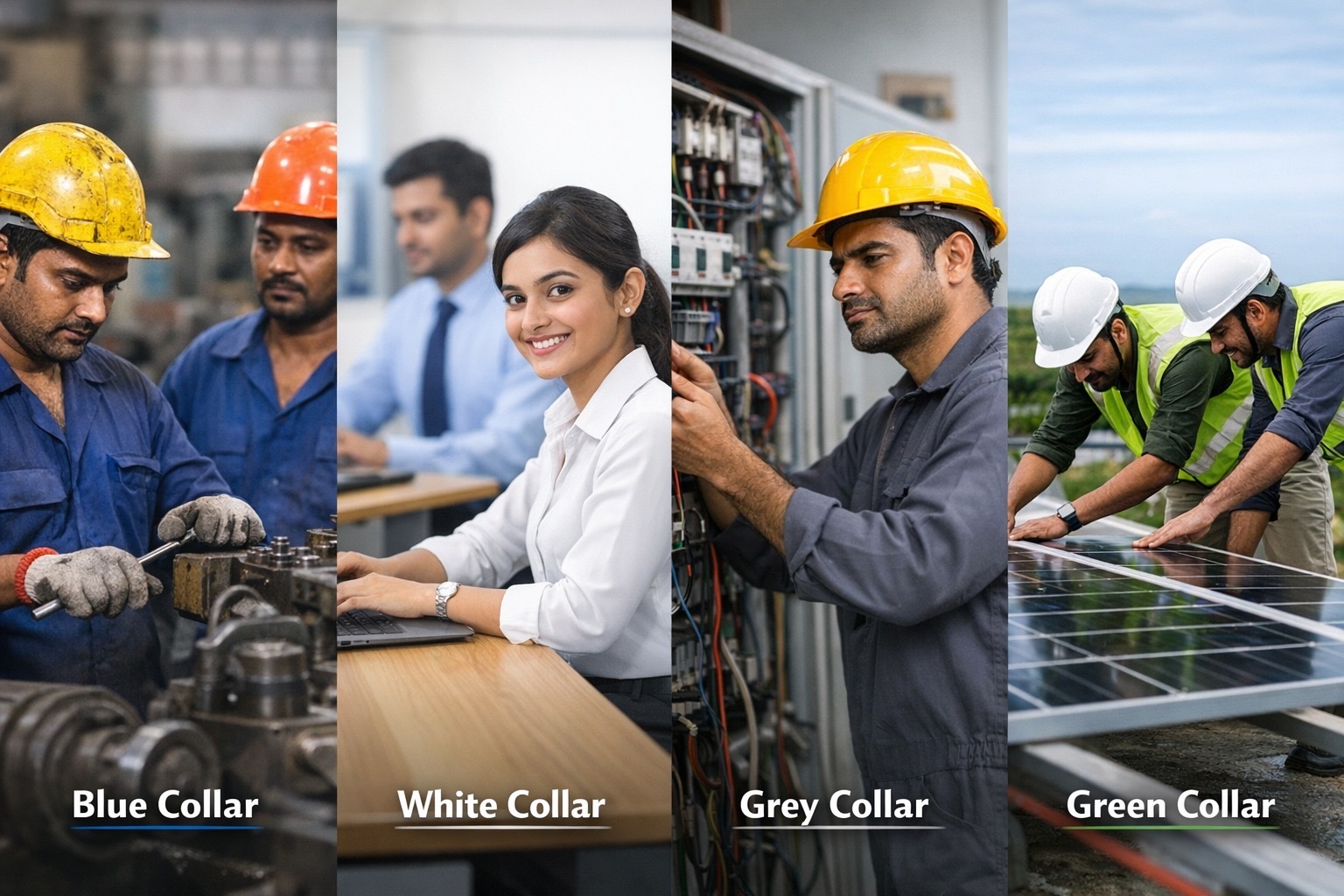
And Why the Future of MSME Hiring Lies in Blue, Grey, Green & Entry-Level White Collar Jobs
India’s workforce is often described using “collar categories.”
These terms represent the nature of work, skill levels, and working environments across industries.
While the terms originated decades ago, they still help us understand how economies function and where employment opportunities exist. From factory floors to corporate boardrooms, every type of worker plays a role in driving economic growth.
But in India - especially in MSME-driven economies like Tamil Nadu and Puducherry — certain collar segments are becoming far more critical than others. Let’s explore them.
Blue Collar Workers
The Backbone of the Real Economy
Blue-collar workers perform manual, operational, and technical tasks that keep industries moving.
These workers typically operate in sectors such as:
- Manufacturing
- Construction
- Logistics
- Automobile service
- Warehousing
- Hospitality
- Retail operations
Common roles include:
- Machine operators
- Drivers
- Electricians
- Welders
- Helpers
- Delivery staff
- Technicians
These jobs require practical skills rather than purely academic qualifications.
Despite being the backbone of India’s production economy, blue-collar hiring remains highly fragmented, with many MSMEs still relying on word-of-mouth recruitment.
As industries expand, the demand for reliable and verified blue-collar talent continues to rise rapidly.
White Collar Workers
The Knowledge and Administrative Workforce
White-collar professionals typically perform desk-based, managerial, administrative, or knowledge-intensive roles.
These roles exist in sectors such as:
- Finance
- Information Technology
- Administration
- Marketing
- Human Resources
- Corporate management
Examples include:
- Accountants
- HR executives
- Sales managers
- Software developers
- Marketing professionals
White-collar jobs often require formal education and specialized knowledge, and recruitment for these roles has largely shifted online over the past decade.
However, entry-level white-collar roles in MSMEs often remain underrepresented on major job portals.
Grey Collar Workers
The Skilled Technical Specialists
Grey-collar workers combine technical expertise with hands-on work.
They are usually trained professionals who bridge the gap between blue-collar operations and
white-collar supervision.
Typical examples include:
- Lab technicians
- CNC operators
- Automotive technicians
- Healthcare technicians
- Electrical maintenance specialists
- Industrial supervisors
These roles require technical training or diplomas, and they are increasingly essential in India’s modern
manufacturing ecosystem.
In many industries, grey-collar talent shortages are becoming a major bottleneck for growth.
Green Collar Workers
The Emerging Workforce of a Sustainable Economy
As sustainability becomes central to economic planning, green-collar jobs are gaining importance.
These workers contribute to environmentally responsible industries.
Typical roles include:
- Solar panel installers
- Wind energy technicians
- Waste management professionals
- Environmental technicians
- Sustainable agriculture workers
India’s renewable energy push is expected to create millions of green jobs in the coming decade.
For MSMEs participating in this transition, finding skilled green-collar workers will become increasingly important.
Why Collar Categories Matter for MSMEs
For small and medium businesses, hiring is rarely about filling just one role.
A typical MSME might need:
- Machine operators (Blue Collar)
- Technicians (Grey Collar)
- Accountants or admin staff (Entry-Level White Collar)
- Sustainability support roles (Green Collar)
However, most hiring platforms focus heavily on corporate or IT hiring, leaving MSMEs underserved.
This gap slows down recruitment and increases operational costs for small businesses.
The Real Hiring Challenge in Tamil Nadu and Puducherry
Tamil Nadu is one of India’s most dynamic MSME economies.
Across cities and industrial clusters like:
- Coimbatore
- Tiruppur
- Hosur
- Chennai
- Madurai
- Dindigul
- Puducherry
Businesses are constantly searching for skilled operational workers and entry-level professionals.
Yet many employers still depend on:
- Referrals
- Local agents
- Informal networks
These methods often limit the reach of potential candidates.
Where Jobanya Fits
In Jobanya was built with a clear focus:
To simplify hiring for MSMEs and connect them with the workforce segments they rely on the most.
The platform primarily supports hiring in the following categories:
✔ Blue Collar
Factory workers, helpers, drivers, delivery staff, machine operators.
✔ Grey Collar
Technicians, supervisors, skilled operators, technical specialists.
✔ Green Collar
Workers involved in renewable energy, sustainability, and environmental services.
✔ Entry-Level White Collar
Accountants, office assistants, telecallers, sales executives, administrative staff.
Empowering MSMEs with the Right Talent
For MSMEs across Tamil Nadu and Puducherry, the real need is not complex recruitment systems.
What they need is:
- Access to the right workforce
- Localized hiring reach
- Faster recruitment cycles
- Reliable candidate discovery
By focusing on the workforce categories that power small businesses, Jobanya aims to strengthen the employment ecosystem where it matters most.
The Future of Work Is Closer Than We Think India’s workforce is evolving.
But one truth remains unchanged:
Economic growth depends not only on innovation or technology, but also on the millions of workers who build, operate, repair, manage, and sustain our industries every day.
From factory technicians to renewable energy installers, from office assistants to machine operators - each collar of work plays a vital role in shaping the country’s future.
And ensuring that these workers and employers find each other efficiently is what platforms like Jobanya
strive to achieve.